


Identify patient risk early and prevent avoidable complications
Improve patient safety, optimise capacity, and reduce costs by automatically identifying patients at risk of complications, without adding workload for clinical staff.
Move from manual, inconsistent screening to fully automated risk stratification across all inpatients. By using existing hospital data, the solution generates individualised risk profiles in real time, supporting earlier intervention and more efficient care delivery.
Instead of relying on resource-intensive screening processes, healthcare organisations gain a consistent, data-driven approach to preventing complications such as delirium and malnutrition, reducing length of stay, improving outcomes, and delivering measurable economic value.
Solutions integrated with vitagroup HIP:
Personalized Risk Tool (PRT)
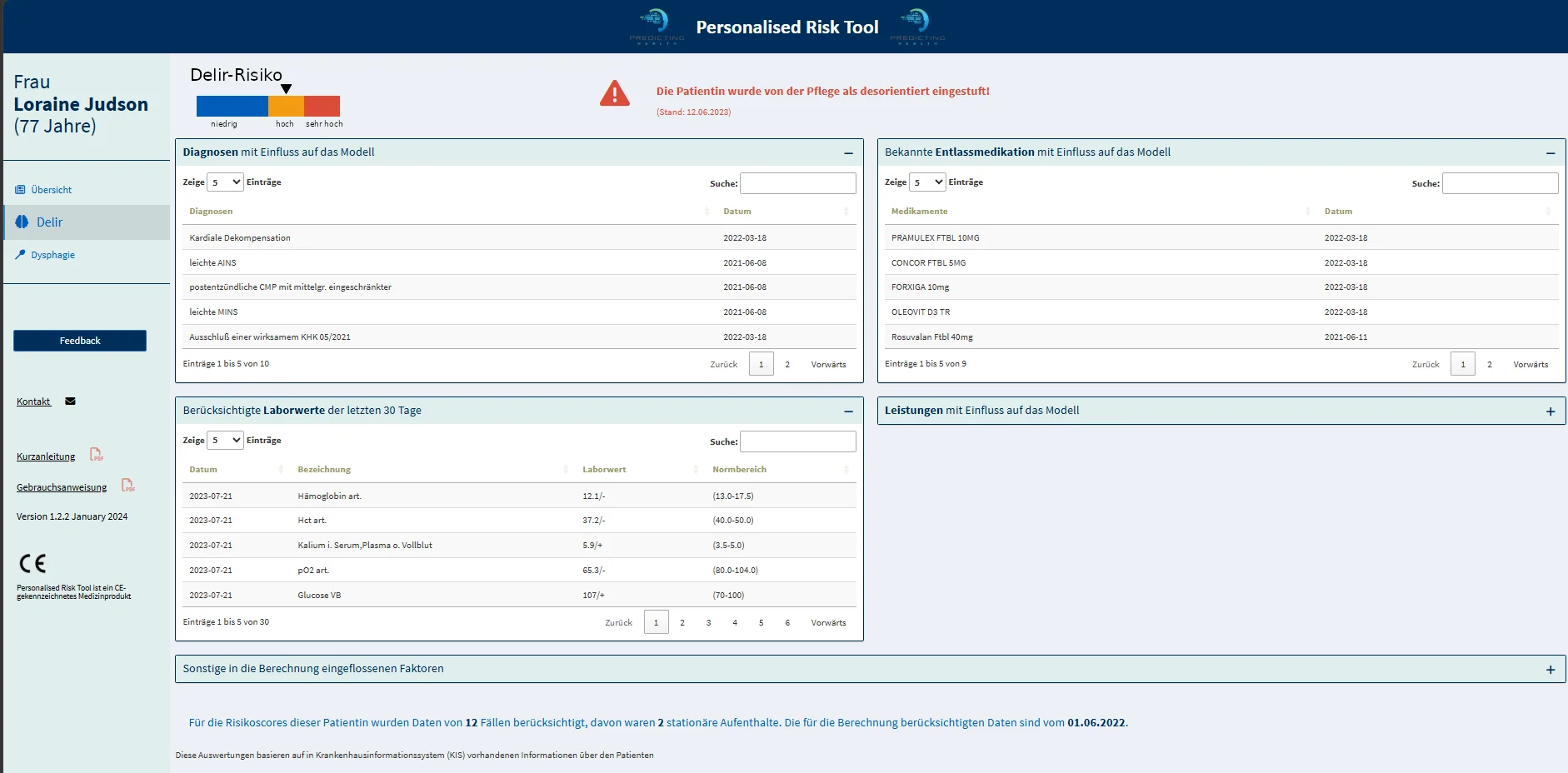
A CE-certified medical device for automated patient risk stratification, the solution uses existing hospital data, including EHR, lab, medication, and nursing documentation, to generate individualised risk profiles without manual data entry, with a focus on preventing avoidable complications such as delirium, falls, malnutrition, and dysphagia, while operating fully automatically and based on clinically validated risk models.
Key benefits:
- Clinically proven in real-world hospital settings (Austrian hospital networks)
- CE-certified medical device for predictive analytics
- Scalable across hospitals, nursing homes, and outpatient care
- Reduces manual workload for clinical staff
- Improves patient safety while reducing costs and improving efficiency
- Delivers measurable economic impact by reducing complications and length of hospital stay
Key features:
- Automated risk stratification
- Integration with EHR, lab, medication, nursing documentation
- Individualised risk profiles without manual entry
- Fully automated screening of all inpatients
Current usecases
Predicting Health is used to identify patients at high risk of complications such as delirium, falls, malnutrition, and dysphagia, enabling earlier intervention. It supports post-surgical care by predicting the likelihood of ICU admission or complications, allowing more proactive planning. In elderly care settings, it helps detect risks such as falls and malnutrition. The solution is also applied in preventative care by enabling targeted measures based on individual risk profiles.