


From paperwork to discharge in minutes
Reduce documentation workload, accelerate discharge processes, and free up clinician time by automating medical documentation directly within hospital workflows. By replacing manual writing with structured, AI-supported processes, organisations can improve efficiency, reduce errors, and ensure more consistent, high-quality clinical documentation.
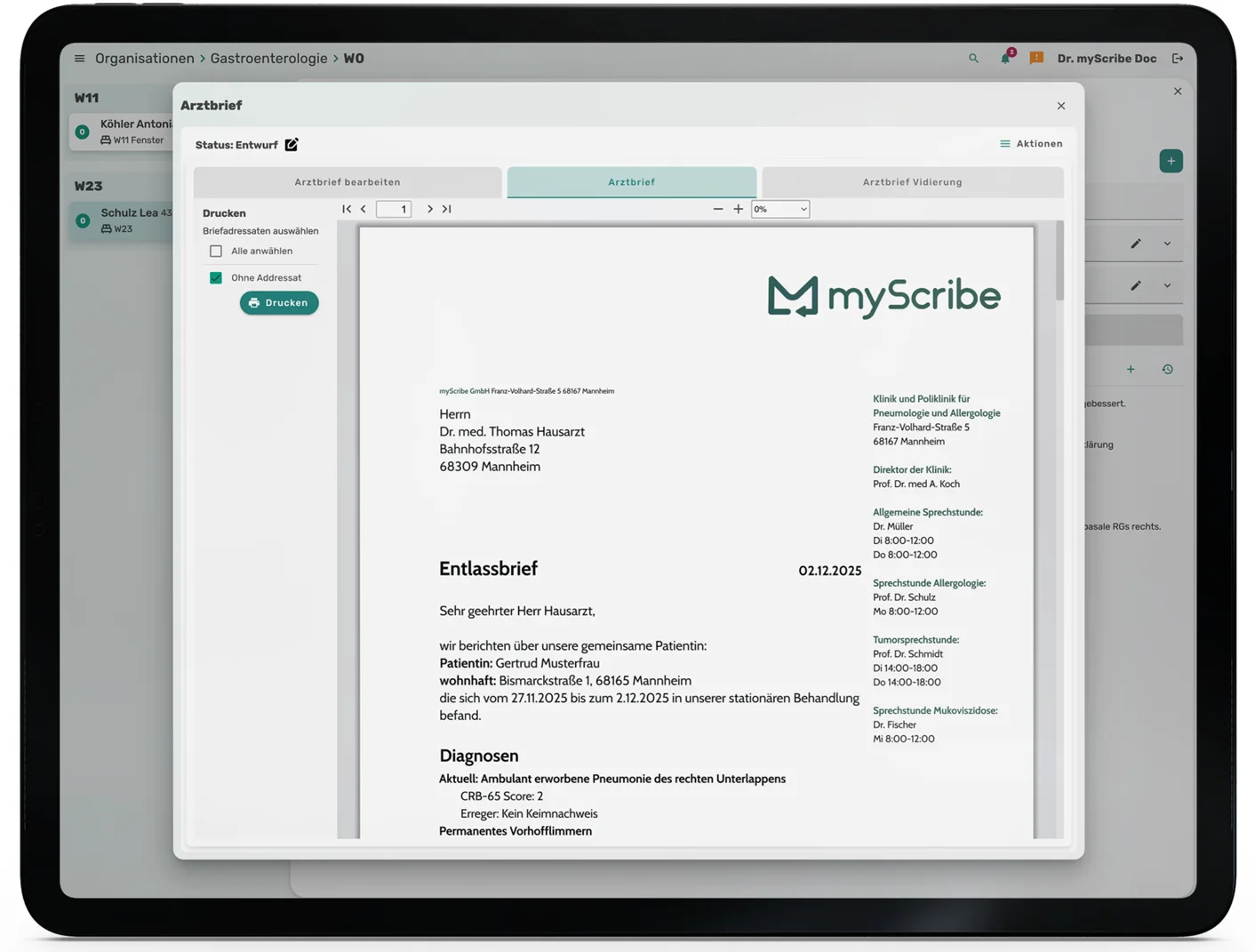
myScribe transforms clinical documentation into an automated, data-driven process. Instead of manually compiling discharge letters, summaries, and reports, clinicians are supported by AI that generates structured, compliant documentation in seconds, using existing patient data and real-time inputs.
Solutions integrated with vitagroup HIP:
myScribe documentation platform
An AI-driven platform for automated clinical documentation, discharge management, and structured data capture integrated into hospital systems.
Key benefits:
- Saves up to 2–3 hours per physician per day by reducing documentation workload
- Accelerates discharge processes, reducing turnaround times significantly
- Improves documentation quality and reduces errors through structured, AI-generated content
- Frees up clinical time for patient care and training
- Enables cost savings and efficiency gains through reduced administrative effort
Key features:
- AI-generated discharge letters and medical summaries from structured patient data
- Automatic population of documents using data from hospital information systems
- Configurable templates for discharge letters, epikrisis, and clinical reports
- Digital admission and intake forms integrated into hospital workflows
- Real-time updating of patient summaries during ward rounds
Current usecases
The solution has been tested in a university hospital setting (Universitätsklinikum Mannheim), where it was evaluated for workflow optimisation.
In hospitals, myScribe supports discharge management by automating the creation of discharge letters and epikrisis. During daily ward rounds, it helps clinicians keep patient summaries and visit lists up to date. In admission processes, digital intake forms reduce manual data entry and improve data quality.